Are Right and Wrong Right or Wrong?
...on the question of morality.

Approx 11 min Read
I wish that right and wrong could go back to being universal truths.
“When I was a child, I talked like a child, I thought like a child, I reasoned like a child.” - 1 Cor 13:10 When I was a child, the world was a beautiful place full of evil that could be eradicated by the light. It was concrete and sure - each person, each thing having its proper place and meaning.
I knew that murder was bad and charity was good. I knew that prostitution was awful and that teaching was wonderful. I knew that science was important and that faith could move mountains. These were irrefutable facts. These were immoveable objects. And I knew that, even if some people were confused about right and wrong, right and wrong were not confusing. Good people and especially great people knew. And, if I could find those people, and align myself with them, we could change the world.
“When I became a man, I put the ways of childhood behind me.”- 1 Cor 13:10 This line from first Corinthians chapter thirteen used to fill me with a sense of pride and purpose. I knew that this was the noble journey of becoming that each person had a responsibility to live - to truly “grow up” – and I was intent upon getting there as quickly as possible. I had no idea what it really meant to touch the sun.
Most of my readers have already made the transition from child to “man” or are in the process of it now. We have lived the cost of that path. We know that what Paul is describing is not a process of growth, but a death - a dying to become awake, a scalding flame. Slipping from the beautiful dream of childhood hurts and the fall that follows is petrifying.
Suddenly, nothing you once knew-beyond-measure-to-be-true can be claimed. Certainty, the bosom buddy of youth, leaves your side; the painful halls of doubt open their gaping doors and swallow you.
Is murder always bad? When could it possibly be “good”? What about necessary? Was murdering Hitler good or bad? Osama Bin Laden? Jeffery Dalhmer? What about charity? When does it harm? How does it wound? Can you be certain what you are doing is “good”? Has the twenty-years I’ve devoted to my kids in Rwanda been indisputably good, or have I been as misguided as so many of the humanitarian efforts I have seen come and go from that land in those years? What is a savior complex and how does it harm? When is thinking you hold the answers what prevents the other from learning the question?
Prostitutes? Are there people who sell their bodies from an empowered place? Is there room in that world for truth and beauty? And what about teachers? What’s the difference between teaching and brainwashing? Is there a single lesson that has ever been taught that was free of prejudice and bias? In whose hands does teaching become the most dangerous weapon known to man? And how do we know when we are serving a weapon or serving a worthy ideation?
Is science as dangerous as it is important? How many women were lobotomized in the name of “science”? How many children leeched? How many animals slaughtered and Africans poisoned to advance science? And, if faith truly does move mountains, how did the conquistadors, the collonisers, manage to march, unobstructed, across the plains of the Americas and wipe out an entire race of the faithful? Surely those tribes were praying and postulating with all their might to the Great Spirit. Believing, believing…right to their death.
On and on the questions rage, ruthless in their rape and murder of childhood surety. “Are you sure you’re good?” It pushes and prods. “Are you sure they’re bad?” It forces you down off your pedestal, and on your knees it asks you to put your face in the dirt and breathe in the only sure thing: “You were made from dust, and to dust you will return.” – Genesis 3:19
This weekend, I had to be tough on my fourteen-year-old son. He broke my rules and I doled out consequence. He thought I was unreasonable and claimed innocence. I had to choose my path – to believe him and honour his claim, or draw a hard line that says, “A rule is a rule, innocent or not.” Underneath this decision was more than just a rule, there lay my broken and beat up morality. I’ve always believed in “washing my disciples feet” and “turning the other cheek”, and yet… And yet to acquiesce too much to a young boy can teach him toxic relationship dynamics. When is service and grace a disservice to the value of grace?
As I grappled with my decision, the conflict between myself and the “flesh of my flesh” hurt and I wanted someone to talk to. But, as I considered my options of people to reach out to, I was faced with the fact that each and every one of those people had a different idea of right and wrong than I have. I searched my coffers for someone who might see this situation just as I did and came up bare: Mom? Dad? Big sister? Little sister? I went through each friend, my boys’ father, coworkers and each person that I considered calling, I could predict exactly what their perspective on the situation would be based on their unique brand of morality. There is no “right” or “wrong” here, I thought. As usual, only consequences that can not be predicted.
I am a one on the Enneagram personality scale (https://www.enneagraminstitute.com/). This means that I have very, very intense ideas of right and wrong and will spend my whole life trying to bring “rightness” into the world. As my friend Ryan O’Neal so perfectly describes in his Enneagram 1 anthem:
“Hold on for a minute,
‘Cause I believe that we can fix this over time -
That every imperfection is a lie…
Or at least an interruption.
Now hold on, let me finish…
No, I’m not saying perfect exists in this life.
But we’ll only know for certain if we try.”
This is my life’s anthem, whether I like it or not. It is how I was fearfully and wonderfully made. But, what it also means is I feel unbearably lonely when nobody else sees right and wrong as I do. A glitch in my unique system? Or a universal human longing?
Hegemony gets a bad wrap nowadays. All the movies are about standing out from the crowd, swimming upstream and sloughing off family and tradition to service your dreams. This has been the prevailing Western narrative for nearly half-a-century now. Is this by design? What lies are we being sold?
Carl Jung speaks masterfully about the relationship between individuation and unity. He understood and spoke so eloquently about the fact that “this being human”, in a profound cosmic joke, requires both. We must understand and live by our own individual dharma, but we cannot do that effectively, happily or healthily without understanding and living within the nourishing embrace of our communal nature.
I am what Jung would describe as a “solitary”:
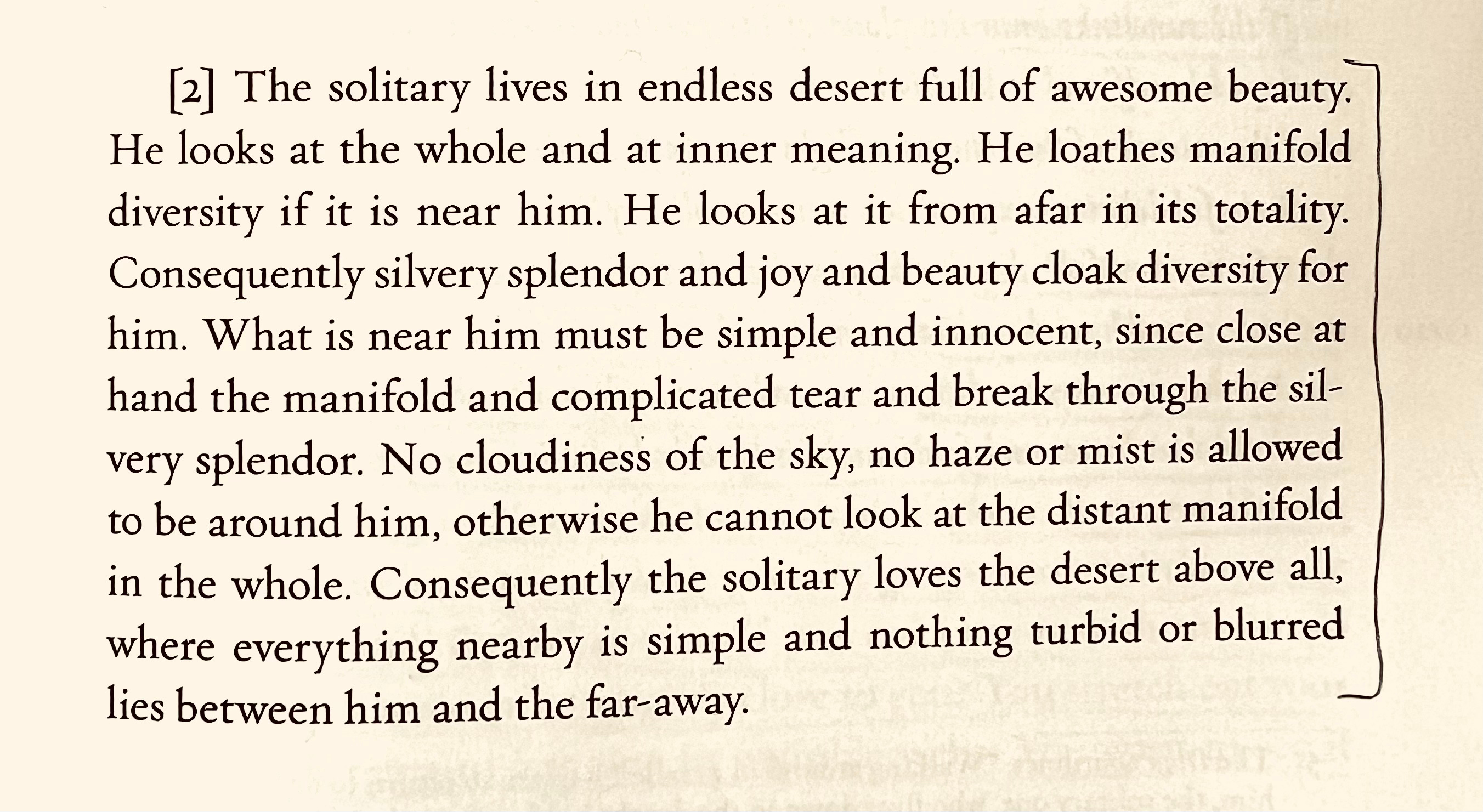
I long to return to the desert of my childhood, where I could look at all the diversity from afar and admire its awesome beauty. But, I know that it is in the challenging turn of every relationship that I grow. “We create the truth by living it”, not by retreating and theorizing about it. And, as much as I’d like to return to the dusty dunes of my youth, “the places that used to fit me, cannot hold the things I’ve learned…and those roads were closed off to me, while my back was turned.”-Sara Groves
**Quote: “We create the truth by living it.” -Carl Jung
Just two verses later, “For now we see only a reflection as in a mirror; then we shall see face to face. Now I know in part; then I shall know fully, even as I am fully known.”
Is it necessary to have belief to find “truth?” I have always accepted that faith is belief without proof. Yet I must “believe” this passage that “truth” will be revealed later. This, of course, is about divine “truth.”
Applying that (shaky) thought to human “truth,” there seems to be a call to humility in understanding that our own knowledge is imperfect and we must keep experiencing our way into truth. And I lean toward believing that the communal truth (morality?) is “greater” than each individual’s sense of his or her own “truth.”
This one will take some more sitting.
You have this subtle way of surprising me.
I know a lot of people, but almost no one makes me pause the way you do.
Everyone’s unique, sure sure. But there’s something about you. The way you think, the way you speak… it’s different in the best way. I can’t fully explain it, but I can’t ignore it either.
Sometimes I feel like I’ve found something rare, like a collector who recognizes the value before anyone else does. And I really like that I get to see it. 😌✨